How to Text in French: Complete Guide to Texting in French
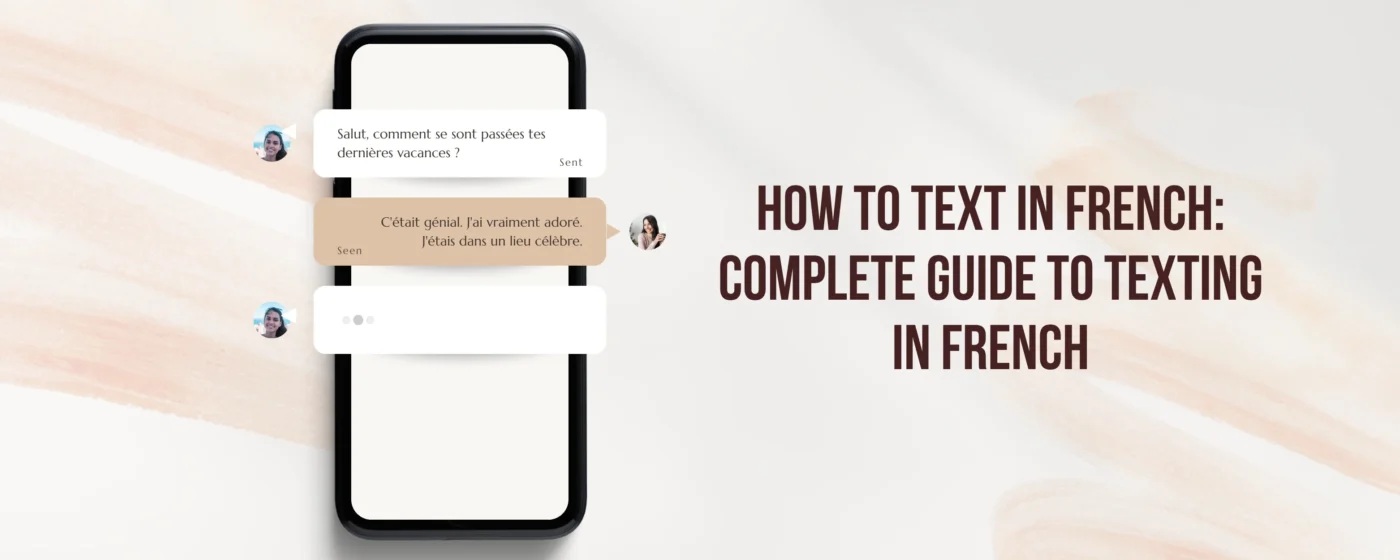
Have you ever stayed up till 3 am texting your friends? Wouldn’t it be fun to do the same in French language. Texting in French follows the same rules as texting in English. Conversation in any language does not limit only to speaking, it also involves writing and especially in modern day texting.
While French texting might not follow the strict rules of formal writing, it’s a fantastic way to practice casual conversation. You may be a student or just a traveler visiting France, it would be nice to learn the colloquial French. This is also called ‘registre familier’. When you are among friends, classmates and people you know well you use these words.
Key Takeaways
- You will be able to clearly understand the informal ways of speaking and texting in French.
- You will understand the native slangs that are used by a French person.
- Words like C’est, ça va dsl will be easy to pick and even use at the right context.
- Formal texting and French slang will be clearly understood.
- By reading natural conversations you will better understand the French texting language.
- You will learn the different ways of texting and you will start texting in French without hesitation.
Why Texting in French is Different from English?
The French language has it’s own variety and style. French speakers are fond of their accents, expressions, and abbreviations. Text abbreviations are often used to save time. For example, “c’est” and “ça va” are commonly used in texts and in informal contexts. Also, for example,” tjr ” stands for toujours, and bcp means beaucoup .
You will learn all these nuances and gradually develop an idea of French texting. Unlike in English, French people are polite, and hence they have “tu” and “vous ” to differentiate between friends and senior persons. You will therefore find “s’il te plaît” (please) and “merci” (thank you) even in casual texts.
“Bisous” is generally used to sign off, especially among friends. So, if you’re learning French, you will get to know all these expressions and abbreviations.
Common French Texting Abbreviations and Meanings
A native French speaker does not use proper grammatical form while texting. In French texting we see bonsoir becoming bsr. Standard French is replaced by shortening words or abbreviation. Spellings are not always correct and words and SMS are written in different French texting rules.
Some example of real French text messages are below:
French text: Salut ! Qd tu étais à Paris ?
Meaning: Hi! When were you in Paris?
French text: MDR, c’est pas grave.
Meaning: LOL, it’s not a big deal.
French text: JTM, à ce soir.
Meaning: I love you, see you tonight.
French text: RAS aujourd’hui.
Meaning: Nothing to report today.
You will encounter a lot of French abbreviations in French texting .This makes French a unique language for non native speakers. Here are some of the most popular abbreviations you can learn:
| French Abbreviation | English Translation |
|---|---|
| Bjr – Bonjour | Hello/ Hi |
| Stp – S’il te plaît | Please |
| Mci – Merci | Thank you |
| A+ – À plus | Goodbye |
| À tt – À tout à l’heure | See you later |
| Cqfd – C’est quoi ce foutoir? | What’s up? |
| Jtm – Je t’aime | I love you |
| Keske (Qu’est-ce que) | What |
| DSL (Désolé) | Sorry |
| Ki (Qui) | Who |
| T (T’es) | You are |
| QD-Quand | When |
| Tu fous-Tu es fou ? | Are you crazy? |
| Sais pas-Je ne sais pas | I don’t know |
Essential French Phrases Used in Informal Text Messages
When you delve into the world of texting in French, you ought to know some French phrases that are commonly used in regular conversation in an SMS or text. You started learning French language and you came across French grammar, French vocabulary. You will be surprised to see much of that grammar is not followed in the French texting.
There are certain words that are shortened and there will be phrases that are shortened. However there will be a distinct difference in formal texting and informal texting in French. You can learn some of the informal text messages that are commonly used below:
| Informal French Phrases | English Translation | Usage |
|---|---|---|
| Ça va? | How’s it going? | A classic way to start a conversation |
| T’es chaud(e)? | You up for it? | Perfect for making plans with friends |
| C’est quoi le délire? | What’s the deal? | Ideal for asking about something strange or confusing |
| Je m’en fous! | I don’t care! | Expressing indifference, in a friendly way |
| C’est nul! | That’s lame! | Expressing disappointment or disapproval in a casual manner |
| T’es sérieux(se)? | You’re serious? | Expressing disbelief or surprise |
| C’est trop cool! | So cool! | Showing enthusiasm and approval |
| Quoi de neuf ? | What’s new? / What’s up? | Common opening line in a casual conversation. |
Formal French Texting Etiquette for Professional Communication
French people follow certain etiquette while speaking or while communicating via un sms whenever it comes to a professional space like while in an office setting or in a school or a college. Whether you are messaging a manager, teacher, client, or recruiter, the tone should remain polite and closer to formal writing than casual conversation.
While writing text messages whether you are messaging a manager, teacher, client, or recruiter, the tone should remain polite and closer to formal writing than casual conversation.
Earlier writing letter was one of the major mode of communication, however in this generation we have sms or even we can dial a number and speak. Communication has only become easier and simpler.
So we also see the same thing in texting. The words and phrases are shorter and simpler. If you also want to learn the amazing useful phrases used in regular French texting you can refer below:
| Formal French Phrases | English Translation |
|---|---|
| Bonjour Monsieur/Madame | Good morning Sir/Madam |
| Bonsoir Monsieur/ Madame | Good afternoon Sir/Madam |
| Au revoir Monsieur/Madame | Goodbye Sir/ Madam |
| Bonne journée/soirée | Have a good day/ good evening |
| Je vous remercie | Thank you very much |
| Je vous prie de croire/ d’agréer, Monsieur/Madame, l’expression de mes sentiments distingués | Please accept, Sir/Madam, the expression of my distinguished greetings |
How Emojis Affect Tone in French Text Conversations
Have you ever come across a text message with a face symbol with lot of kisses in it or a thumbs up symbol. This is the most common kind of symbols that are found in regular text messages. They are called Emojis. They add emotion, tone or a personality to a message. It often helps in avoiding misunderstandings and dialing down a tone of an intended message.
You can find that the French in the same way use emojis in their sms. Also they add expressions like bisous, gros bisous, to convey affection and warmth.
However, French emojis can be a minefield if you do not know the context. If you add emojis anywhere and everywhere without giving a thought, it can be rude to the reader. For example a casual wink to a serious reader can lead to misunderstanding. So it is better to read and understand your audience and carefully use the emojis to have the best conversations.
Lost for Words? We’ve Got You!
Sign up for our courses and let our expert teachers boost your vocabulary effortlessly!
French Slang and Informal Texting Vocabulary
French people use slang in their regular informal conversation as well as texting. While it is not specifically about vulgar words, it is a part of it. Here is another dimension of slang known as verlan.
Apart from verlan, there are unique accents and slang that are used in different regions of France. You will learn more of these slangs once you travel to more local places and speak with native French people.
French texting, like any language, has its own unique slang and abbreviations. Here are a few common ones:
| French Slang / Abbreviation | Meaning in English | Full Form / Explanation |
|---|---|---|
| Ouais | Yes | Informal way of saying Oui |
| Trop | Too much / Very | Commonly used in informal French to mean “very” |
| MDR | Dying of laughter | Mort de rire |
| TQ | Don’t worry | T’inquiète |
| BG | Handsome guy | Beau gosse |
Initially, using French slang can be difficult. This will gradually come more by French reading or French texting. Interactions with local French people will introduce you to more of this French slang. As this varies from locality to locality, the slang also varies accordingly. Not all French slangs are known to all native French speaker.
You will be surprised to know that the slangs and their meanings keep changing from one place to another. So do not hesitate to ask or clarify the meaning of any French words, acronyms, or slang.
French Texting Do’s and Don’ts for Clear Communication
If you want to learn French texting, the best way is to indulge in more texting. You need to practice while knowing that even native French speakers make a lot of grammatical mistakes while texting, and that is totally fine. When in doubt, ask an expert and clarify. A lot of broken words from spoken French are used in texting language.
As long as we know in which context you are texting ,keeping in mind the locality, the professional or informal background of the receiver, you can engage in French texting with ease.
Here are certain do’s and don’ts you can follow while texting in French:
Do’s:
- Embrace the Emojis: Use them wisely! A well-placed emoji can convey emotions better than words. Just don’t overdo it, or you might end up looking like a digital clown.
- Master the Art of Abbreviations: Make “t’es” and “c’est” your new best friends. They’ll save you precious typing time and impress your French friends with your linguistic greatness.
- Be Polite, Even in Text: A simple “Bonjour” and “Merci” can go a long way. Remember, French politeness is a thing, even in the digital age.
- Don’t Be Afraid to Ask Questions: If you’re unsure about something, just ask!
Don’ts:
- Overuse Slang: While slang can be fun, it’s important to use it appropriately. Avoid using too much slang in formal texts, or you might come across as unprofessional. Oh la la!
- Ignore Punctuation: Punctuation is important in French, even in texts. Don’t neglect it, or your message might be misinterpreted.
- Forget the Accents: Accents are a crucial part of French spelling. Don’t be lazy; take the time to add them. Your French friends will appreciate it.
- Translate Word-for-Word: This is a surefire way to sound awkward and unnatural. Instead, try to think in French and use natural expressions.
Commonly Used French Texting Words
Native French speakers use often use shorten words or abbreviations in their spoken French or sms. Learning these French words will keep you once step ahead in the French learning journey and once you are able to understand and use these French words in your regular conversations, you will feel more natural and confident.
Here are some of the most commonly used French texting words and expressions:
| French Expression | Meaning in English | Full Form / Explanation |
|---|---|---|
| Salut ! | Hi! | Informal greeting |
| Ça va ? | How are you? | Informal way to ask how someone is doing |
| Oui | Yes | |
| Non | No | |
| J’sais pas / JSP | I don’t know | Je ne sais pas |
| Pk ? | Why? | Short form of Pourquoi ? |
| Tkt | Don’t worry | T’inquiète |
| Stp | Please | S’il te plaît |
| Mdr | LOL / Laughing out loud | Mort de rire |
| A+ | See you later | À plus |
| Bjr | Hello / Good morning | Bonjour |
| Bsr | Good evening | Bonsoir |
Natural Conversation Examples
| French Expression | Meaning in English | Full Form / Explanation |
| Salut, ça va ? | Hi, how are you? | Informal greeting |
| JSP, je te dirai plus tard. | I don’t know, I’ll tell you later. | JSP = Je ne sais pas |
| Pk tu réponds pas ? | Why aren’t you replying? | Pk = Pourquoi |
| Tkt, tout va bien. | Don’t worry, everything is fine. | Tkt = T’inquiète |
| D’acc, à tt ! | Okay, see you soon! | D’acc = D’accord; à tt = à tout à l’heure |
| Mdr, c’est trop drôle ! | LOL, that’s too funny! | Mdr = Mort de rire |
If you master such French words and phrases it will make you more fluent in French and make it easier to speak with native speakers. If you want to continue learning French grammar, and improve your conversational skills, visit La Fôret French Class.
Did You Know?
People who text in French have their own unique abbreviations and slang. For example, “MDR” stands for “Mort de rire” (Dying of laughter).
Frequently Asked Questions
Q1. Are there any specific texting etiquette rules in France?
Ans: While there aren’t strict rules, it’s generally polite to avoid texting during meals or important social gatherings. Also, be mindful of the time, especially late at night.
Q2. Is it common to use voice-to-text in French texting?
Ans: Absolutely! Voice-to-text is becoming increasingly popular in France, especially when people want to send longer messages quickly without typing every word. However, it can sometimes misunderstand pronunciation or produce grammatical errors, so it’s always a good idea to proofread your message before sending it.
If you wish to become more confident with everyday French communication, texting, and conversation? La Forêt French Class offers French courses designed to help learners build practical language skills alongside exam preparation for DELF, TEF, and TCF.